
RC Filters & Low Pass Gates
Learn how RC audio filters work, make them voltage-controlled with Vactrols and build the Low Pass Gate from our LOW module.
This is the second hands-on audio electronics course created by Bread Modular.
In this course, we are going to build a Vactrol-based Low Pass Gate. It's the exact circuit inside our LOW module:
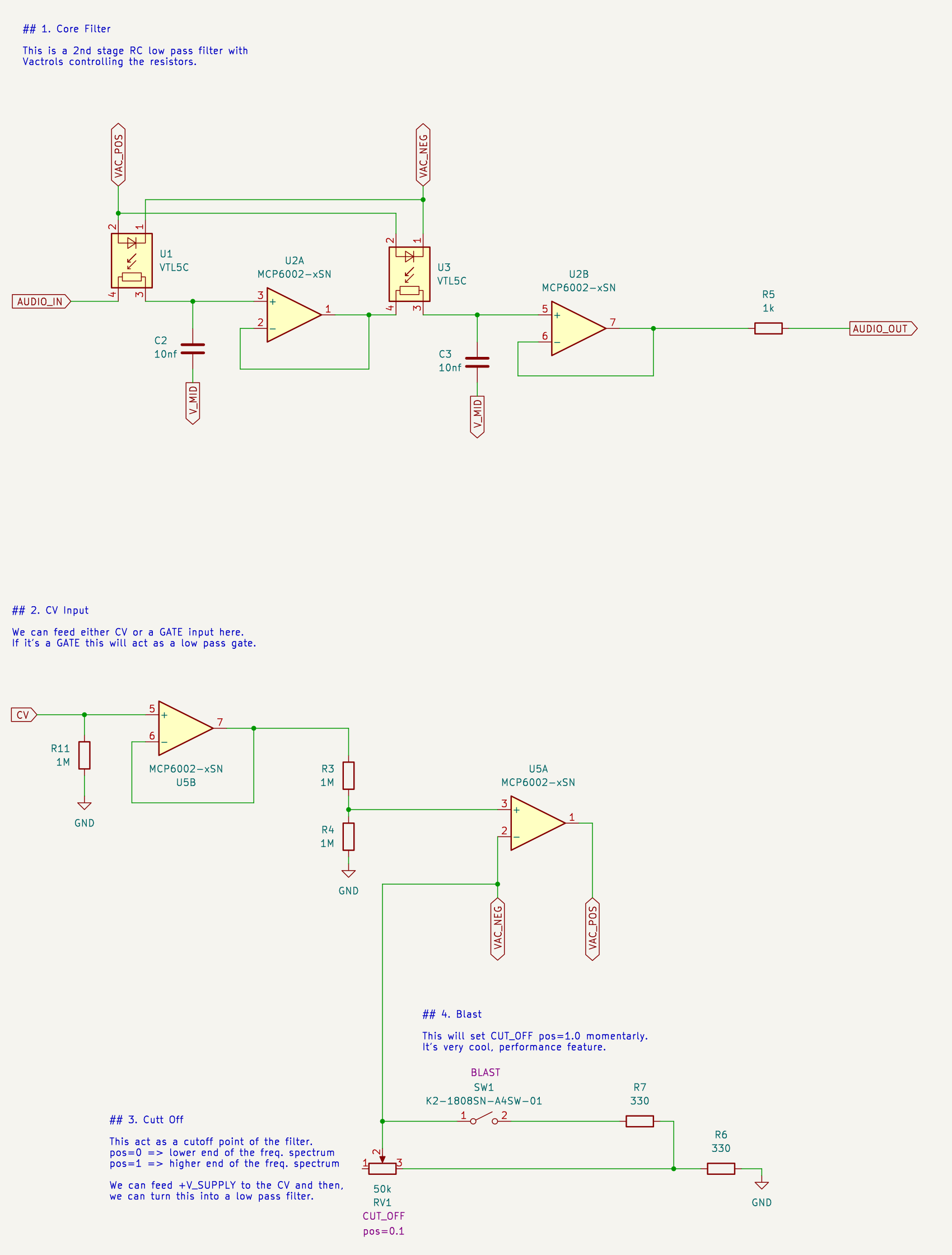
By the end of the course, you will understand every part of the above diagram: how a resistor and a capacitor make a filter, why we stack two of them, and how a couple of Vactrols turn it into a filter (and a gate) you can control with a voltage.
Just like the previous course, we learn by building and listening. We use a few simple formulas, but mostly we rely on approximations, the oscilloscope and our ears.
💡 This course builds on top of the Introduction to Audio Electronics course. Make sure you are comfortable with voltage dividers, the 10X rule, opamp buffers and Vactrols before you start.
💡 This course is meant to be used with the Bread Modular Lab Kit. But you can learn the concepts and use them with your own electronics lab setup too.
Lessons
- 1
Capacitors
Learn what a capacitor does, read capacitor codes and watch a capacitor charge through a resistor.
- 2
The RC Low Pass Filter
Build a first-order RC low pass filter, calculate its cutoff frequency and hear it in action.
- 3
The RC High Pass Filter
Swap the resistor and the capacitor to make a high pass filter and learn how capacitors block DC.
- 4
Cascading Filters
Stack two RC filters to get a steeper 12dB/octave filter, see the loading effect again and fix it with buffers.
- 5
The Voltage-Controlled Filter
Replace the resistors with Vactrols to control the cutoff frequency with a voltage, and drive them properly with an opamp.
- 6
Building the Low Pass Gate
Put everything together, build the LOW module on the breadboard and use it as a filter and a Low Pass Gate.